How to Pay in China as a Tourist (2026): Alipay, WeChat Pay, Cards and Cash


Содержание статьи
- How tourists pay in China: the quick version
- The setup I’d travel with now
- Alipay and WeChat Pay with a foreign card
- Can I pay with Visa or Mastercard in China?
- Cash in China: do you still need it?
- Pay for big items before the trip
- Metro, buses and taxis
- Why you need internet to pay
- What to do if a payment fails
- Before you fly: payment checklist
- FAQ
Short answer: set up Alipay (or WeChat Pay) with a Visa or Mastercard issued outside China before you fly, bring a second card from a different bank, and carry a little cash in yuan in small notes. China pays by QR code almost everywhere. Your foreign card works best as the money source inside a wallet app, and direct card payment is a bonus, not a guarantee.
Checked November 2026. Fees, limits and app rules change, so always read the final payment screen before you confirm.
Affiliate disclosure: this article contains affiliate links. If you book through one of them, I earn a small commission at no extra cost to you.
Before my first trip, what scared me wasn’t the app itself. It was the thought of standing at a till with a queue behind me, a cashier who only speaks Chinese, and a payment that won’t go through. After 51 days in China my answer is simple: don’t look for one magic method. Build a main option and a backup before you leave.
How tourists pay in China: the quick version
| Method | Good for | My take |
|---|---|---|
| Alipay with a foreign card | Shops, cafés, metro, taxis, mini-programs | Main method |
| WeChat Pay with a foreign card | A second QR wallet, some mini-services | Good backup |
| Visa / Mastercard directly | Hotels, airports, big stores and attractions that show the logo | Useful, but small places often want a QR code |
| Cash (yuan) | No phone, no internet, a failed payment | Carry some, but not as your only plan |
| Travel eSIM | Everything above needs data | Set it up before you fly |
The setup I’d travel with now
- Main: Alipay with a card that’s already linked and tested.
- Backup: a second card from another bank, or WeChat Pay as a second wallet.
- Cash: a modest amount in small notes for the first day and emergencies.
- Internet: a travel eSIM that works the moment you land.
This looks like overkill right up until your first declined payment. After that you’re very glad you don’t have to message family from a Chinese airport.
Alipay and WeChat Pay with a foreign card
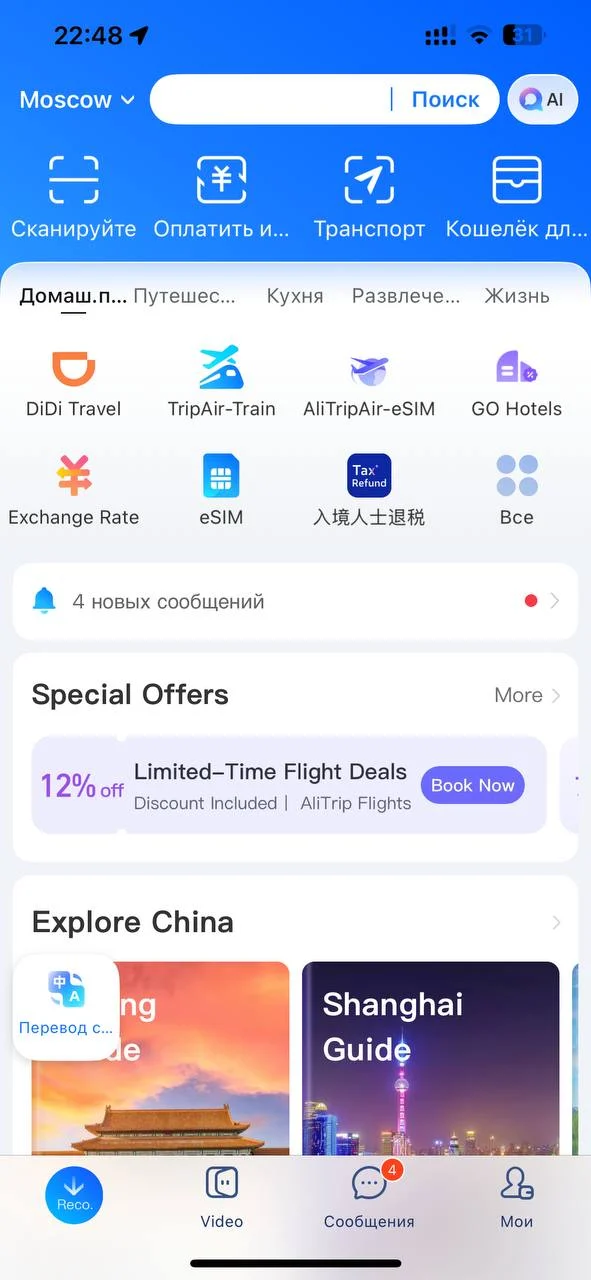
Both apps let visitors link a card issued outside mainland China, so you don’t need a Chinese bank account. Official numbers from the Shanghai government’s payment page (checked November 2026):
| Item | What the official page says |
|---|---|
| Card limits | Up to US$5,000 per transaction and US$50,000 per year. The app shows the limits for your account. |
| Platform fee, 200 yuan or less | Generally no fee |
| Platform fee, above 200 yuan | Up to 3% of the full amount (a 500-yuan payment adds 15 yuan). Check the payment page for the fee and any promotion. |
| Exchange rate | Set by your card network and bank, not by the app. Your bank may add its own foreign transaction fee. |
The app may ask you to verify your identity with your passport, and some features, such as the metro QR code in Alipay, need verification first. Step-by-step setup is in Alipay for foreigners.
There are two normal ways to pay: you scan the seller’s code, or you show your code to the cashier. That’s the whole mechanic. After the first two days you stop treating every payment as a tech quest. You open the code, pay and walk on.
I used Alipay as my main method and paid for the metro, taxis, cafés, shops and Taobao orders with it.
Can I pay with Visa or Mastercard in China?
Sometimes. Hotels, airports, large shops and tourist sites that show the card logo can take foreign cards. Bank of China says you can use overseas cards at its merchants where the logo is displayed, and otherwise ask the cashier. A small café may simply expect a QR code, so treat direct card payment as a bonus.
Take at least two cards from different banks and keep them in different places. If one is lost or your bank blocks a transaction, you still have a way to pay. Before you fly, check with each bank:
- that foreign transactions are allowed and China isn’t blocked;
- your daily and foreign limits and the conversion fee;
- that the banking app and SMS codes work abroad;
- your physical card PIN for ATMs.
Cash in China: do you still need it?
Yes, as a backup. Cash in yuan is legal tender, and a new People’s Bank of China rule in force since 1 February 2026 says businesses that take payment in person generally must not refuse cash. In practice, a small stall may not have change for a 100-yuan note, so carry small notes.
I took far more cash than I needed, and most of it came home with me. Now I’d take a sensible reserve in small notes and set up the main payment method in advance. Cash isn’t the main plan. It’s peace of mind for a flat phone, no signal, or a wallet that decides to run a security check right at the till.
Getting yuan: official guides say you can exchange money at bank branches and exchange machines at international airports, or withdraw yuan at ATMs with an international card. Bank of China ATMs accept overseas UnionPay, Visa, Mastercard, JCB and American Express cards, with a 3,000-yuan limit per withdrawal. Your own bank sets the fees and the other limits. If the ATM offers to convert into your home currency, choosing yuan usually means your bank does the conversion instead of the machine.
Pay for big items before the trip
I prefer to pay some big costs at home. I book hotels, flights and train tickets on Trip.com, where the total is easy to see and I’m not testing Alipay for the first time on an expensive purchase.
Check hotels in China on Trip.com →
See China train tickets on Trip.com →
Metro, buses and taxis
Metro and buses. In big cities you can open a transport QR code inside Alipay. Some places also sell single tickets and transport cards. I used Alipay: once it’s set up, it’s faster than buying a single ride every time.
Taxis. DiDi works inside Alipay and as a separate app. Pick the address on the map instead of trying to say the hotel name to the driver. The fare is charged after the ride to your chosen payment method.
Why you need internet to pay
Alipay, the transport code, DiDi and mini-programs all depend on your phone. So paying starts with connectivity. I buy an eSIM in advance and switch it on before the flight, so I can open my apps right after landing. My travel eSIM opened my usual services without anything extra and worked across mainland China and in Sanya. Hotel Wi-Fi is a local network and doesn’t work the same way. More in best eSIM for China.
See the eSIM I used on Trip.com →
What to do if a payment fails
Rule one: don’t press pay five times in a row. First check your payment history. Sometimes the money has already gone and the seller’s confirmation is just late.
If there really is no payment, switch to your backup: another card in the wallet, the second wallet app, a physical card, or cash.
Before you fly: payment checklist
- Choose your main method (Alipay or WeChat Pay).
- Register with a phone number that receives SMS abroad and verify your passport if asked.
- Link a card and check that it’s accepted.
- Prepare an independent backup and some cash in small notes.
- Tell your banks you’re travelling, if they ask for it, and save their international phone numbers.
- Make sure you’ll have internet right after landing.
The most expensive mistake is leaving payments until the Chinese airport. Wallets may need SMS codes, your passport, bank confirmation and stable internet. At home it’s all much calmer than after a night flight.
FAQ
What is the best way to pay in China as a tourist?
Alipay with a foreign Visa or Mastercard as your main method, a second card or WeChat Pay as a backup, and a little cash in yuan.
Does China accept Visa and Mastercard?
Hotels, airports, big stores and tourist sites that show the logo often do. Small shops and cafés usually expect a QR code, so link your card to Alipay or WeChat Pay.
How much does Alipay charge foreigners?
According to the Shanghai government’s payment page, payments of 200 yuan or less are generally free. Above 200 yuan a fee of up to 3% of the full amount may apply. Your bank may add its own foreign transaction fee.
Can I pay cash in China?
Yes. Yuan cash is legal tender, and since 1 February 2026 businesses serving customers in person generally must not refuse it. Carry small notes, because change can be a problem.
Alipay or WeChat Pay: which is better for tourists?
For a trip, I find Alipay more convenient because transport, taxis and other services are inside it. WeChat Pay works well as a second wallet.
Do I need internet to pay with Alipay?
Yes, for the wallet, transport codes, DiDi and checking payments. Set up an eSIM or another connection before you land.
ПУТЕШЕСТВИЯ PEROKSA
Больше маршрутов и материалов о путешествиях
Бюджеты, маршруты и личный опыт — без воды и с реальными цифрами.
Смотреть все материалы →